CONVERSION CHECK · 16 NOVEMBER 2026
MP3 to MIDI Returns No Notes? Check Stereo Phase First
If a stereo recording sounds clear but Hummingtomidi finds no notes, listen to its left and right channels separately before changing formats. This tool averages the decoded channels. Equal, opposite-polarity signals cancel in that average. Try exporting the clearer channel as a mono WAV. This is one specific cause of an empty conversion, not a diagnosis for every recording.
Try the converterWhat our controlled test actually found
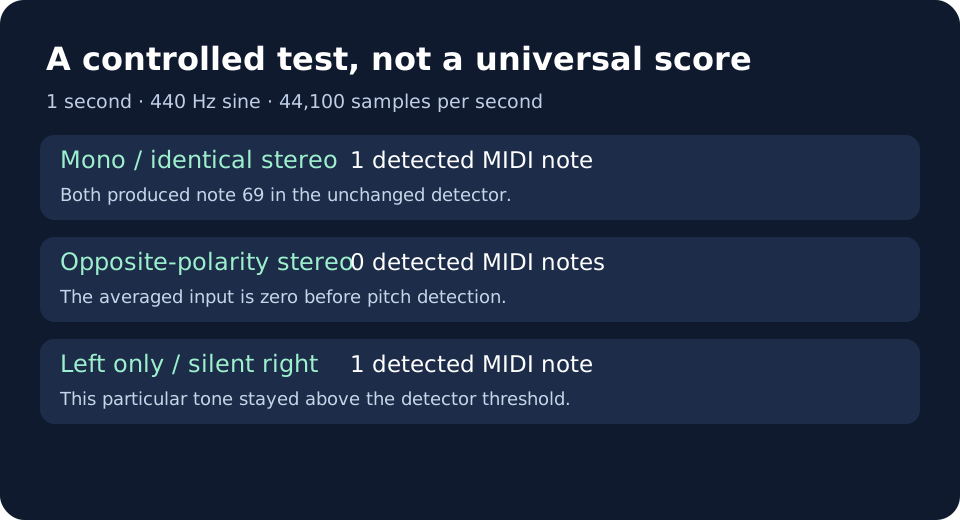
We called the unchanged Hummingtomidi detector directly with four synthetic decoded audio buffers. Each buffer contained one second of a 440 Hz sine wave at a sample rate of 44,100 Hz. The peak amplitude was 0.4 in floating-point sample units. The only thing we changed was the relationship between the channels. These are generated tones we own, so you can download and inspect them without needing a commercial recording.
| Input | Channel relationship | Detected notes | MIDI pitch |
|---|---|---|---|
| Mono | One channel | 1 | 69 |
| Identical stereo | Right equals left | 1 | 69 |
| Opposite-polarity stereo | Right equals negative left | 0 | None |
| Left only | Right is silent | 1 | 69 |
The detected note in the three successful cases lasted about 0.966 seconds. That is the detector's event duration, not the source duration: the source is exactly one second. Windowing and note grouping determine the event boundary. Do not interpret the shorter event as a measurement of MP3 encoder delay; this experiment did not encode or decode MP3 at all.
The exact operation behind the empty result
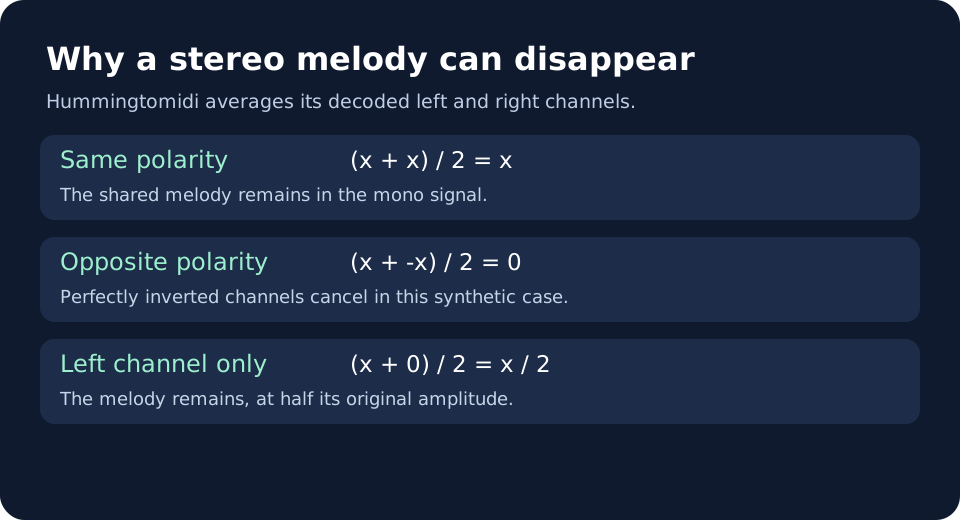
The detector reads channel zero and, when a second channel exists, calculates their arithmetic average before measuring pitch. In the inverted case, the two numbers add to zero at every sample. Pitch detection cannot recover a melody from an all-zero input. With identical channels, averaging preserves the original signal. With one silent channel, averaging halves the non-silent signal. Our chosen left-only tone remained detectable; a quieter recording might not.
The detector also contains a quiet-window rejection threshold of 0.008 RMS. That value comes from this site's source, not an industry standard. A file can therefore fail without perfect cancellation: a quiet recording or a partial cancellation may drop enough windows below this threshold to interrupt note tracking. This is an inference from the code path, not a measured failure rate for real recordings.
Download the exact evidence
The four mono, identical stereo, opposite-polarity stereo and left-only WAV files reproduce the channel relationships. The result JSON records the sample count, detector output and source SHA-256. The test script shows the method; to run it locally, point its source path to your copy of app.js. No private recording or remote transcription API is involved.
This is a direct function test of the current note detector and MIDI writer. It is not a browser compatibility test, a codec benchmark, a test of another service, or a claim about typical music accuracy. The WAV files are a way to inspect the PCM case independently. Real MP3 decoding, microphones, stereo effects and recording noise can make the cancellation incomplete. Use the evidence to investigate a symptom, not to label every silent conversion with the same cause.
A practical check for your own recording
- Keep the original file. Open a copy in an audio editor that can split stereo into separate mono tracks.
- Listen to the left channel alone, then the right alone. Choose a channel with an audible, isolated melody.
- Export that channel as a mono WAV. Do not simply mix both channels to mono again; that can repeat the cancellation.
- Convert the mono file and compare the note list with the stereo result.
If neither channel contains a clean single melody, investigate the recording itself. A full mix, noise or near-silence can all require a different next step. Changing the file extension cannot add missing notes.
Questions and direct answers
Is stereo always worse for MP3 to MIDI?
No. Identical stereo channels produced the same single note as mono in this test. The issue is the channel relationship and the converter's downmix rule, not the word stereo.
Will converting an MP3 to WAV fix cancellation?
Not by itself. If the decoded channels keep the same opposing samples, averaging them still cancels. Selecting one usable channel changes the signal; saving the same signal in a different container does not.
Should I make the whole file louder?
First check whether the mono signal contains the melody. Multiplying exact zero by a gain factor still produces zero. Gain may help a quiet surviving signal, but it cannot repair perfect cancellation and can introduce clipping if overdone.
Does this mean my speakers are broken?
No conclusion about your speakers follows from this detector test. A stereo listening path and a mono downmix are different operations.
Why not use the other channel automatically?
The tested version uses averaging rather than a channel selector. This article documents that behavior. Exporting a clean channel is a manual workaround, not a promise that the converter already chooses it.